What Do Plasterers Actually Do? A Newcastle Homeowner's Guide
Wondering what plasterers actually do? We explain every service, from skimming to rendering, for Newcastle upon Tyne homeowners. Call us for a free quote.

What plasterers actually do, and why it matters for your home
Plaster is the invisible backbone of almost every room in the house. Most people walk past smooth walls and ceilings without giving them a second thought, but the moment something goes wrong, a crack spreads across the chimney breast, a ceiling starts to sag, or a freshly replastered room needs painting, the questions start. What do plasterers do, exactly? And what should you expect when you bring one into your home?
We are V&D Plastering & Painting, a fully insured trade team working across Newcastle upon Tyne and the surrounding areas. This guide walks you through every service we offer, the situations that call for each one, and what the process looks like from start to finish.
Skimming walls and ceilings
Skimming is one of the most common jobs for a plasterer in Newcastle. It means applying a thin, smooth coat of finishing plaster over an existing surface, either old plaster that has gone rough or uneven, or new plasterboard that has just gone up after a rewire, extension or loft conversion.
The result is a flat, clean surface ready to paint or paper. In older Newcastle properties, Victorian and Edwardian terraces in particular, walls often have several layers of old plaster built up over decades. A fresh skim coat can transform a tired, patchy room without the disruption of a full strip-out.
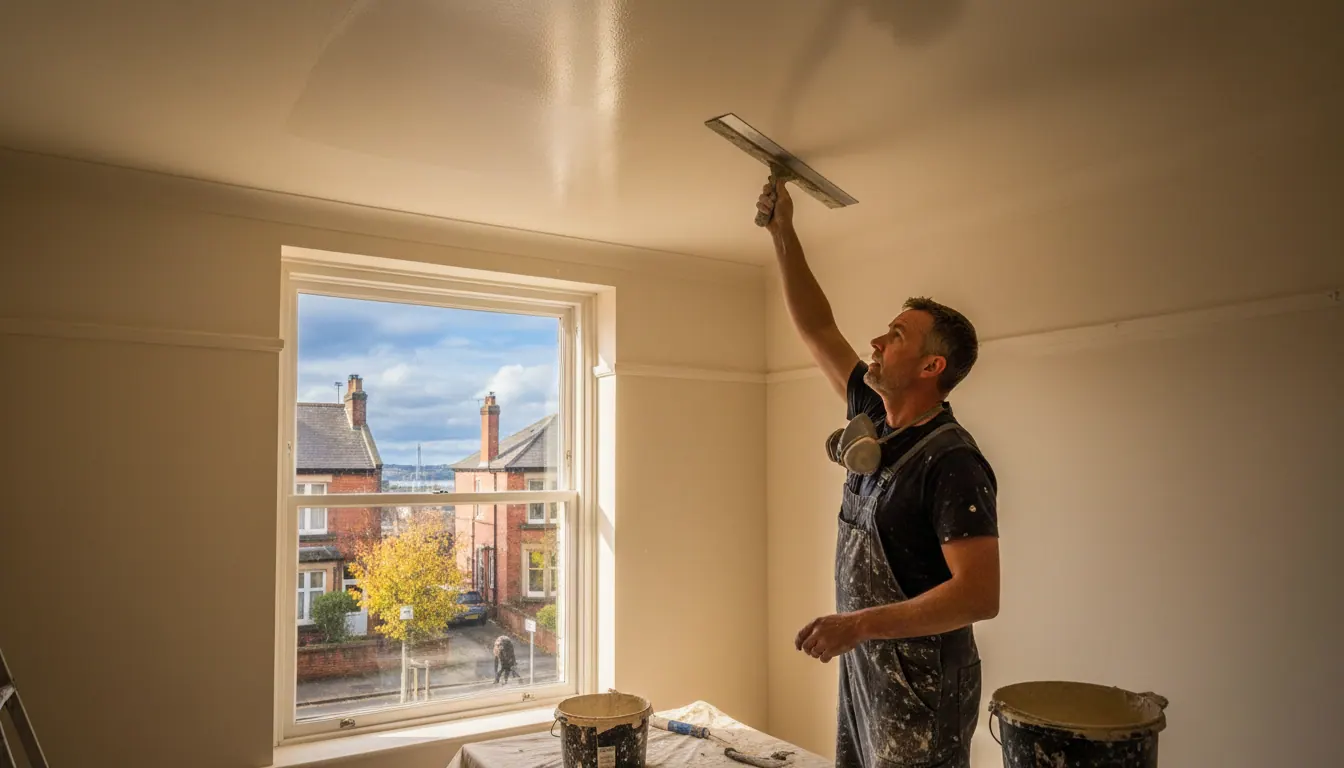
Ceilings are a slightly different challenge. If your ceiling has hairline cracks, has been patched in places, or just looks rough under a coat of paint, skimming brings it back to a consistent finish. If you are wondering how long a ceiling skim actually takes, we have covered that in our article How Long Does It Take a Plasterer to Skim a Ceiling?.
Replastering and full wall plastering
Sometimes a skim coat is not enough. If the existing plaster has blown (you can tell by tapping the wall and hearing a hollow sound), is crumbling, or was never applied properly in the first place, the right answer is to take it back to the brick or block and start again. That is where our internal plastering service comes in.
This is common in Newcastle's older housing stock. Tyneside flats and Victorian terraces often have original lath and plaster walls, where thin strips of timber were fixed across the studs and plaster was applied in layers. When lath and plaster fails, it fails properly. The old material is removed, the background is prepared correctly, and new plaster is applied in the proper coats to give a solid, lasting finish.
Full replastering is also the go-to after building work. If walls have been opened up for new pipework or electrics, or if a partition wall has been removed, the repaired areas need to be plastered to match the rest of the room.
Dry lining
Dry lining is the process of fixing plasterboard to walls or ceilings before skimming. It is faster than traditional wet plastering and is common in new builds and many renovation projects.
Dry lining is used in a few situations across Newcastle homes:
- When an internal wall needs to be built out slightly to hide pipework or cables
- When an internal wall needs a better surface for decoration
- After a rewire, when chased cables have left the walls in a poor state
- In rooms where the existing plaster is too far gone to skim over
The plasterboard goes up first, joints are taped and filled, and then the whole surface gets a smooth skim coat.
Plaster repairs
Not every job needs a full room. Sometimes a single wall has a patch of blown plaster, a doorframe has been knocked and cracked the surrounding plaster, or a previous repair has been done badly and stands proud of the surface.
Our plaster repairs service covers repairs of all sizes across Newcastle upon Tyne and the surrounding areas. Small repairs are matched to the surrounding finish as closely as possible. On older properties with lath and plaster walls, the background needs to be treated correctly before filling, otherwise the repair is likely to crack again.
External rendering
Rendering is plastering for the outside of a building. A rendered finish covers the brickwork or blockwork underneath and gives the property a fresh, even appearance, and in Newcastle, with its damp autumns and cold winters, a well-finished exterior matters.
Rendering often suits:
- Older terraces where the existing exterior coating looks tired or has cracked
- Brick-built semis where the owner wants a cleaner, more modern appearance
- Exposed elevations that take the worst of the Tyneside weather
The render is applied in the correct coats for the surface, finished to the agreed texture, and left ready for painting once it has fully cured. Curing times vary depending on the product and conditions, so we always follow the manufacturer's guidance rather than rushing the next stage.
Interior and exterior painting
Because we cover both plastering and decorating, a job does not need to stop once the plaster is dry. We apply mist coats to new plaster (an important step that a lot of people skip, and one that can lead to paint peeling later), then full finish coats to walls, ceilings and woodwork. See our interior painting page for more.
For outdoor work, our exterior painting service covers rendered and masonry surfaces, from brick terraces to rendered semis. Exterior painting helps keep a property looking well maintained.
What a real customer said about repair work
Our customers on Google regularly mention the tidiness of our work, the quality of the finish and the clear communication throughout. Here is what one reviewer had to say about a plaster repair job:
"We had some badly damaged lath and plaster walls that needed serious attention. The repair work is perfect, and you cannot even tell where the cracks used to be. Truly skilled professionals who clearly take pride in their craft"
Tomas Budi, 5-star Google review
That is the standard we aim for on every job. Dust sheets go down before we start, floors and furniture are protected throughout, and we leave the property clean and tidy when we are done. Plastering is unavoidably a dusty trade, but there is no reason a home should be left in a mess.
What to expect when you call a plasterer
A lot of people are not sure what happens between picking up the phone and having a finished room. Here is the straightforward version of how we work:
- You call us or get in touch to describe the job.
- We arrange a convenient time to look at the work.
- We give you a free quote based on what the job actually involves.
- We agree a start date and talk through any preparation you need to do beforehand (clearing the room, for example).
- We carry out the work, keeping the space as protected and tidy as possible throughout.
- New plaster needs time to dry fully before painting. We will tell you what to expect and what the next steps are.
We are open seven days a week, from 7am to 7pm, so you can reach us whenever suits you.
Frequently asked questions
What are plasterers responsible for on a building project?
A plasterer is responsible for the internal wall and ceiling surfaces: skimming, full plastering, dry lining and plaster repairs. On a renovation or new build, plastering usually happens after the structural and first-fix trades (builders, electricians, plumbers) have finished, and before the decorators come in. Because we handle both plastering and painting, we can often take a room from bare walls all the way to a finished, painted surface.
What should I know before I call a plasterer?
It helps to have a rough idea of what you need done and why. Is the plaster cracked, blown, or just rough? Has there been recent building work? Are you replastering the whole room or just repairing a section? You do not need to know the technical answer; just describe what you can see and we will work out the right approach. It is also worth clearing the room as much as possible before work starts, or at least moving furniture to the centre so it can be covered easily.
What is the difference between skimming and replastering?
Skimming is applying a thin finishing coat over an existing surface. It works when the background is solid and sound. Replastering means removing the existing plaster back to the wall and starting from scratch. It is the right option when the plaster has blown, is crumbling, or is too uneven for a skim coat to fix properly. We will always tell you honestly which approach suits your walls.
Do plasterers work on older Newcastle properties with lath and plaster walls?
Yes. Lath and plaster is common in the Victorian terraces and Tyneside flats found across Newcastle upon Tyne, and it needs a slightly different approach from modern plasterboard. When lath and plaster fails, it usually needs to come off completely. The background should be prepared correctly before new plaster is applied, which is the only way to get a repair that lasts.
Get in touch for a free quote
If your walls need attention, whether that is a cracked ceiling in a Victorian terrace, blown plaster in a Tyneside flat, or a full repaint after replastering, we are happy to come and take a look. We work across Newcastle upon Tyne and the surrounding areas, and you can find out more about our team.
Call us on 07467 216111 or get in touch using our contact form to arrange a free quote.
“Highly recommend best plaster from Newcastle Upon Tyne”